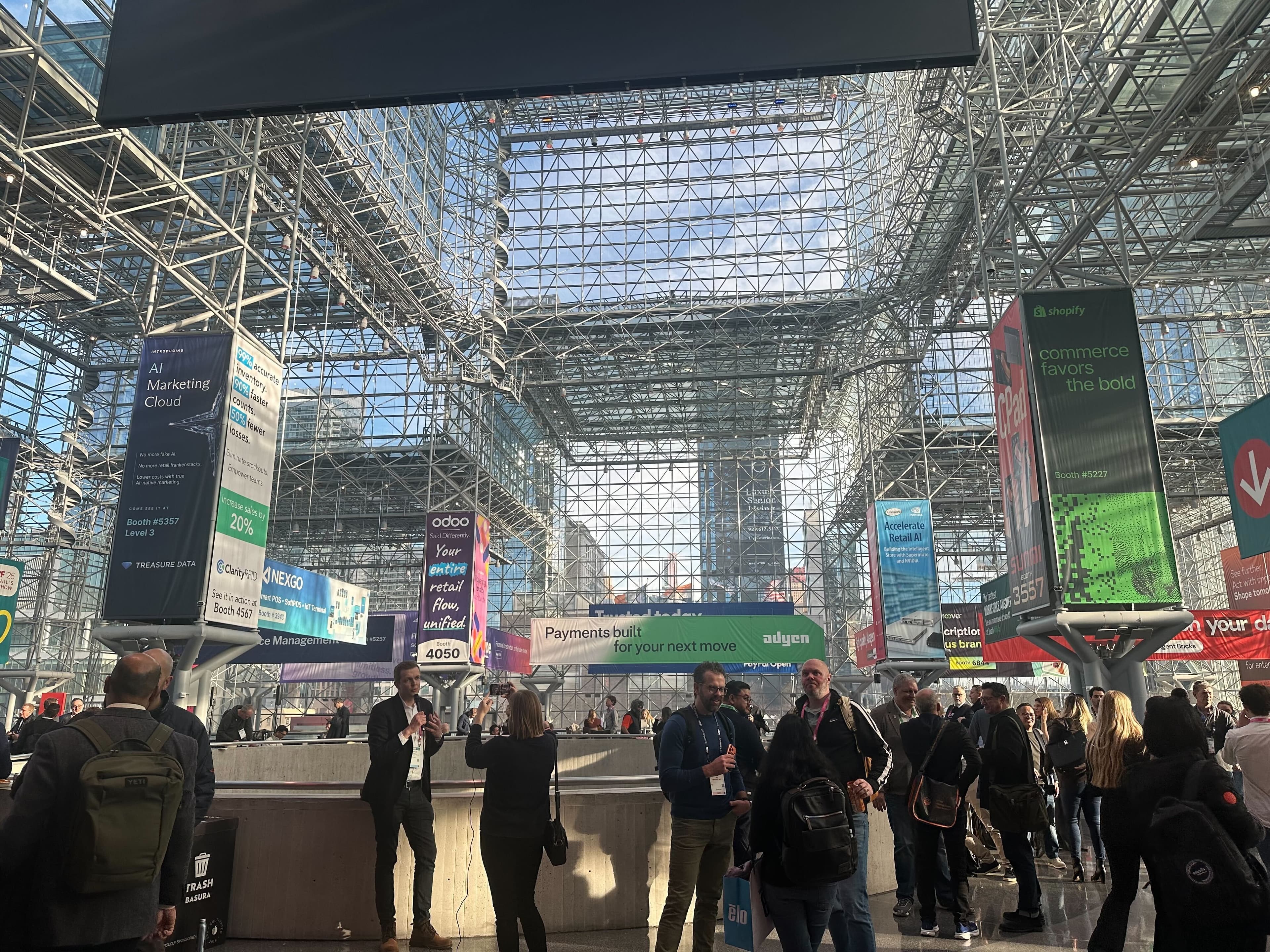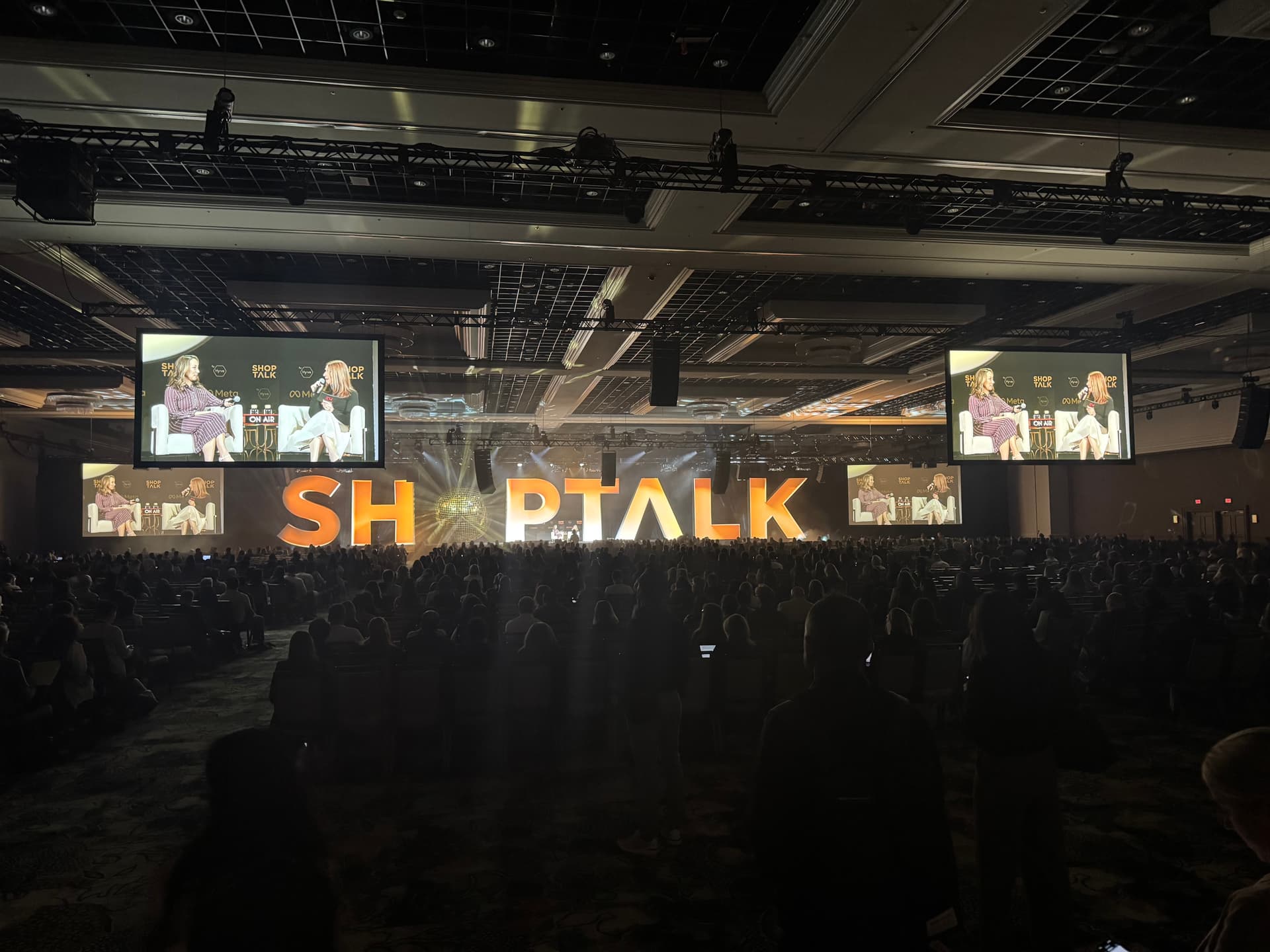
Last week, we spent three days at NRF: Retail's Big Show in New York, meeting with retailers, brands and technology vendors across the expo floor. Amongst the product demos, main-stage sessions and startup pitches, five clear themes emerged. Each signals a deeper shift in how retailers will build, buy and compete over the next 18–36 months.
Below are the ones we believe matter most:
1. Agentic Commerce Has Arrived
Agentic commerce has moved from theoretical framework to live deployment. AI agents are beginning to handle entire shopping journeys, from discovery through to checkout, fundamentally reshaping how retailers think about customer acquisition and transaction flows.
The expo floor showcased this shift in action. ReFiBuy is enabling autonomous purchasing decisions by agents that understand user preferences and budget constraints. Cimulate is building the infrastructure layer that lets agents interact with commerce systems reliably. Vody is taking this further, using agent-driven personalisation to anticipate needs before a human user even articulates them. Atronous rounds out the picture by giving agents the contextual intelligence to navigate complex product catalogues with accuracy.
The implications are significant. When agents become the primary "shopper," merchandising logic shifts from emotional persuasion to data clarity. Product information needs to be machine-readable, pricing needs to be structured, and availability needs to be real-time. Retailers that treat this as an interface challenge rather than a structural one will struggle.
2. Interoperability Is the New Competitive Moat
As AI applications proliferate across retail operations, interoperability is emerging as the critical differentiator. It's no longer enough to deploy best-in-class point solutions if they can't talk to each other. The winners will be those who can orchestrate across systems seamlessly.
Big tech is already targeting this orchestration layer aggressively, recognising that controlling how systems connect matters more than owning the most capable individual model. Meanwhile, startups like Moderne are building what they call "tech stack liquidity," the ability to move data, logic and workflows between platforms without friction or loss. Ekyam is approaching the same problem from a different angle, creating unified data layers that let multiple AI applications draw from a single source of truth.
The strategic implication is clear: retailers need to think about their technology architecture holistically. Siloed AI deployments might deliver local wins, but they create systemic brittleness. Integration capability is rapidly becoming as important as feature capability.
3. The Battle for Share of Tech Stack
In previous years, the assumption was simple: add more tools, unlock more value. That logic has reversed. Businesses are now looking for consolidation, efficiency and ROI clarity. The result? Competition for "share of tech stack" has never been more intense.
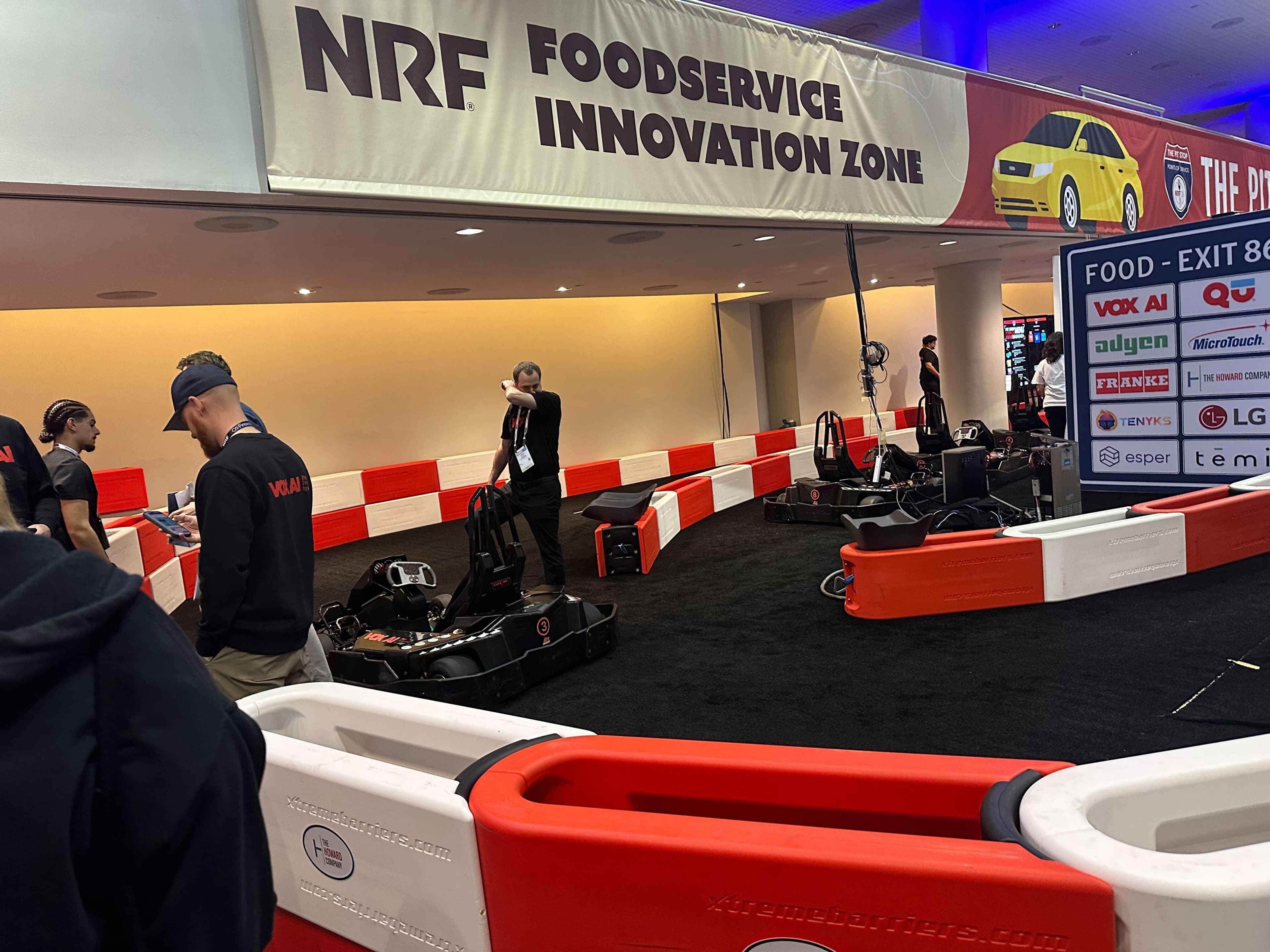
This dynamic was exemplified by Vox AI's presence at NRF. Their voice commerce demo, complete with a show-stopping go-kart drive-through experience, wasn't just theatre. It was a statement: we can replace multiple systems with a single conversational interface. Voice is positioning itself as the ultimate consolidation play, collapsing search, navigation, checkout and support into one interaction layer.
For vendors, this means differentiation can no longer rely on incremental feature adds. The question retailers are asking is: "What can you replace, not what can you add?" Tech stack real estate is finite, and the pressure to justify every square inch is rising sharply.
4. Knowledge Graphs Move from Backend to Battleground
Knowledge graphs have been discussed in technical circles for years, but NRF 2026 marked their emergence into mainstream deployment conversations. Developers are recognising that basic retrieval-augmented generation (RAG) isn't sufficient for reliable AI outcomes. Knowledge graphs provide the structured, contextual foundation that lets AI reason with precision rather than probabilistic guesswork.
Yet despite growing adoption amongst builders, tech buyers still undervalue their significance. Knowledge graphs remain hidden in the backend, treated as plumbing rather than product. That disconnect creates an opportunity gap: vendors who can articulate the commercial impact of graph-based architectures, reduced hallucinations, better recommendations, faster time-to-insight, will win budget that might otherwise go to flashier, less effective solutions.
Atronous, Ekyam and Vody are all building on knowledge graph foundations, embedding structured reasoning into their core offerings. As these systems prove their value in production, expect knowledge graphs to shift from technical necessity to commercial differentiator.
5. AI Levels the Playing Field Between Large and Small
The expo floor told two stories simultaneously. The large incumbents still dominated in booth square footage, budget and brand recognition. But in the conversations happening across the venue, the newer entrants dominated. Their demos were sharper, their value propositions clearer and their roadmaps more ambitious.
AI is compressing the advantage that scale traditionally conferred. A small team with a well-designed AI stack can now build and ship faster than a large organisation hampered by legacy systems and internal bureaucracy. The result is a resetting of competitive dynamics: nimbleness, focus and technical architecture matter more than headcount or marketing spend.
For established players, this is a wake-up call. Maintaining market position will require the operational agility of a startup, even at enterprise scale. For newer entrants, it's validation: the window to disrupt is open, but execution speed is everything.
From Proliferation to Consolidation
NRF 2026 made one thing clear: the era of endless tech stack expansion is over. Retailers are demanding integration, efficiency and measurable ROI. The tools that win will be the ones that simplify operations rather than complicate them, that orchestrate across systems rather than create new silos, and that deliver commercial outcomes rather than technical novelty.
The centre of gravity has shifted. The next wave belongs to vendors who can turn capability into clarity, and complexity into competitive advantage.